

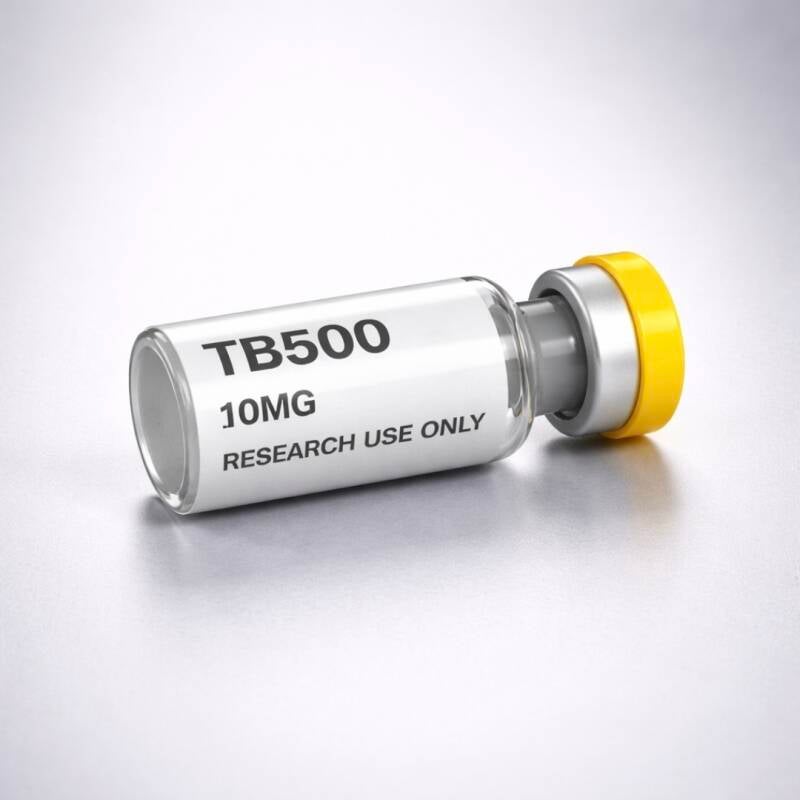
TB-500:
A Peptide Associated with Tissue Repair and Recovery
TB-500 is a synthetic peptide derived from a naturally occurring protein in the body called thymosin beta-4. This protein is found in many tissues and plays an important role in cell movement, tissue repair, and inflammation control. TB-500 represents the active portion of that protein, designed to mimic some of its biological effects. Because thymosin beta-4 is present in nearly all human and animal cells, scientists have been interested in how it helps coordinate healing and regeneration after injury.
One of the key roles of thymosin beta-4—and therefore TB-500—is its ability to regulate actin, a structural protein that allows cells to move and change shape. Cell movement is critical during healing because repair cells must migrate into damaged areas to rebuild tissue. By influencing actin dynamics, TB-500 appears to help cells travel more efficiently to injured sites. This mechanism is thought to be one reason why the peptide has shown promising results in studies involving muscle injuries, tendon damage, and skin wounds.
Research on thymosin beta-4 has demonstrated strong regenerative effects in several experimental models. In studies involving wound healing, researchers found that thymosin beta-4 accelerated the closure of skin injuries by stimulating cell migration and promoting the formation of new blood vessels. In a well-known study published in Nature, investigators observed that thymosin beta-4 increased angiogenesis, the formation of new blood vessels, which helps supply oxygen and nutrients to damaged tissue. Improved blood supply is one of the fundamental requirements for efficient healing.
Another area of research has focused on the peptide’s potential to support muscle and connective tissue repair. Animal studies have shown that thymosin beta-4 can improve recovery after muscle injury by reducing inflammation and enhancing tissue regeneration. In experimental models of tendon damage, treated subjects demonstrated faster healing and better organization of collagen fibers, which are essential for restoring strength and flexibility in connective tissue. These findings have made TB-500 of particular interest in fields studying sports injuries and rehabilitation.
Thymosin beta-4 has also been investigated for its potential effects on the heart and cardiovascular system. In laboratory studies involving cardiac injury, researchers found that thymosin beta-4 appeared to stimulate the migration of cardiac progenitor cells—cells capable of developing into heart tissue. These studies suggested the possibility that the peptide could assist in repairing damaged heart muscle after events such as heart attacks. While these findings are still under investigation, they highlight how the peptide may influence multiple regenerative pathways within the body.
Another important property associated with TB-500 is its anti-inflammatory effect. Inflammation is a natural part of healing, but excessive inflammation can slow recovery and damage surrounding tissue. Research suggests that thymosin beta-4 helps regulate inflammatory signals, creating an environment that supports efficient tissue repair. By balancing inflammation while promoting cell movement and blood vessel growth, the peptide appears to help coordinate several steps of the healing process simultaneously.
Real-world expectations for TB-500 generally focus on its potential to support recovery from injuries involving muscles, tendons, ligaments, and other soft tissues. Because thymosin beta-4 occurs naturally in the body and increases during injury, scientists believe it may act as a biological signal that instructs tissues to repair themselves. The synthetic version, TB-500, is studied as a way to enhance or amplify this natural repair response.
In summary, TB-500 is a peptide derived from thymosin beta-4 that has shown promising regenerative properties in scientific research. By promoting cell migration, encouraging new blood vessel formation, regulating inflammation, and supporting tissue regeneration, the peptide appears to influence several critical processes involved in healing. Continued research aims to better understand its mechanisms and explore how these regenerative effects might one day contribute to treatments designed to improve recovery from injury and tissue damage.